 simba
simbaCS2 Stats Explained: ADR, KAST, Rating and more!
Counter-Strike 2 gives you more data about your own performance than almost any other competitive game, but the problem is, it doesn’t fully explain what these stats mean. This guide breaks down every stat you’ll see on a CS2 scoreboard or a tracker: what it measures, how it’s calculated, what counts as a good number, and which ones to focus most on for improving your skill.
Key Takeaways
- ADR measures the amount of damage you’ve done averaged across all rounds played in the match, and is a good measure of impact
- KAST measures your consistency, how often you’re in the right positions
- K/D ratio is the most overrated stat
- Track trends over time instead of single games
What is ADR in CS2?
ADR stands for Average Damage per Round. The math is exactly what it sounds like: your total damage dealt to enemies, divided by the number of rounds played.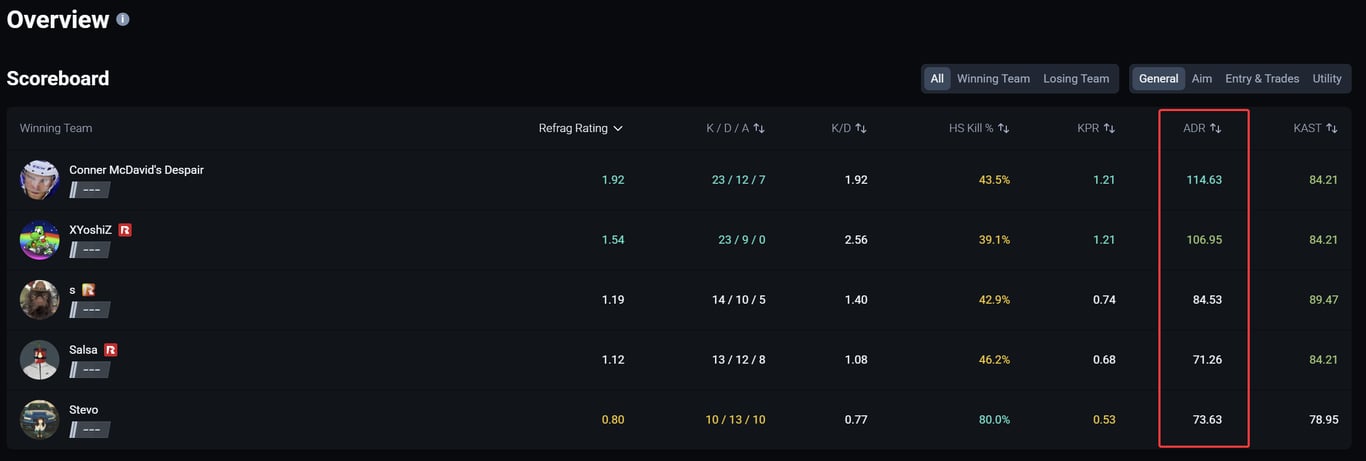
What makes ADR useful is what it captures that kills don’t. If you shoot an enemy for 90 damage and your teammate finishes them with a pistol, the kill goes to your teammate, but the 90 damage is yours, and that could make a key difference in the outcome of a round.
A few details worth knowing about how it’s calculated:
- Utility damage counts. HE grenades, molotovs and incendiaries all feed your ADR. A well-thrown nade stack can add real numbers to your average.
- Damage is capped at enemy health. You can’t deal 300 damage to a 100 HP opponent. Overdamage doesn’t do anything for your ADR stat.
- Team damage doesn’t count. Nading your own teammate won’t hurt your ADR, but it will hurt your friendships.
What is a good ADR in CS2?
Broadly, here’s where the bands fall in ranked play:ADR What it means Under 60 Low, you’re likely not contributing enough damage to win rounds 60–75 Just about average for most matchmaking lobbies 75–90 Good, you’re consistently impacting rounds 90–105 Very strong, we’re in carry territory in most lobbies 105+ You are having about as much impact as you can have based on ADR alone
What does KAST stand for in CS2?
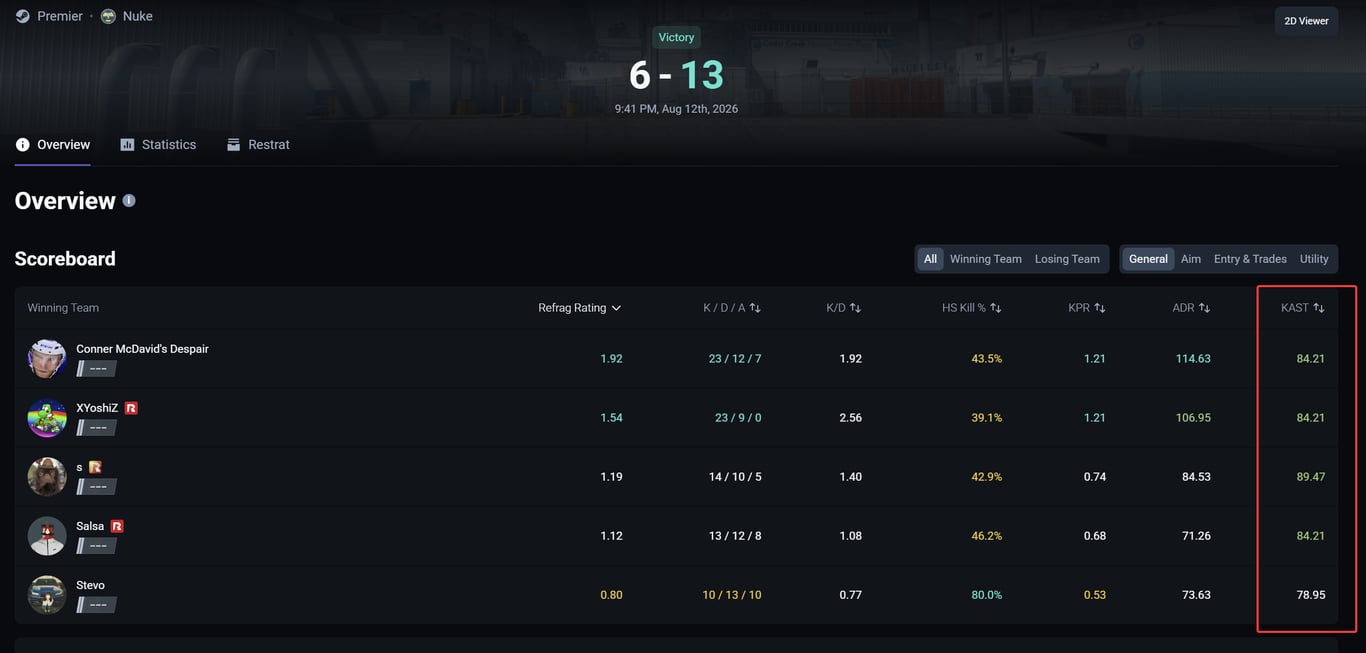
KAST stands for Kill, Assist, Survive or Trade. It’s the percentage of rounds where you did at least one of those four things.
The formula is simple: rounds with a kill, assist, survival or traded death, divided by total rounds played, times 100.
You only need one of the four to count, and doing several in the same round still only counts once. A round where you get three kills counts exactly the same as a round where you got traded out immediately after dying. That sounds like a flaw in the stat itself, but it’s the entire point: KAST isn’t measuring how big and effective your rounds are, it’s just measuring how often you don’t make an impact.
One caveat on the “S”: it isn’t a free pass on every rating system. HLTV’s rating no longer awards a KAST point for saving in a lost round if you didn’t get a kill or an assist, for example.
What is a good KAST percentage?
| KAST | What it means |
|---|---|
| Below 65% | Inconsistent, you’re going missing in too many rounds |
| 65–70% | Below average |
| 70–75% | Solid |
| 75–80% | Very good |
| Above 80% | Excellent, assuming a decent sample size |
How do CS2 ratings work? (HLTV, Refrag, Leetify)
Rating is an attempt to collapse everything above into one number. Several exist, and they don’t all mean the same thing.
HLTV Rating 3.0
The rating you’ll see quoted for pro matches. HLTV replaced Rating 2.1 with Rating 3.0 in August 2025, and adjusted it again that October.
Rating 3.0 is built from six components:
- Kill Rating — your fragging output
- Damage Rating — overall damage contribution
- Survival Rating — staying alive when it matters
- KAST Rating — the consistency component
- Multi-Kill Rating — rounds where you get two or more
- Round Swing — the headline addition
1.00 remains the baseline, representing expected average performance across an event.
Round Swing is the key statistic that was added, and it measures how much each kill actually changed your team’s probability of winning that round. accounting for economy, bomb status, players alive, and specific map CT/T side win rates.
Leetify Rating
Leetify’s rating works on a different scale and leans more heavily on aim and utility mechanics pulled from demo data. It’s one number tracked over time, and it can tell you whether you’re trending up.
Refrag Rating
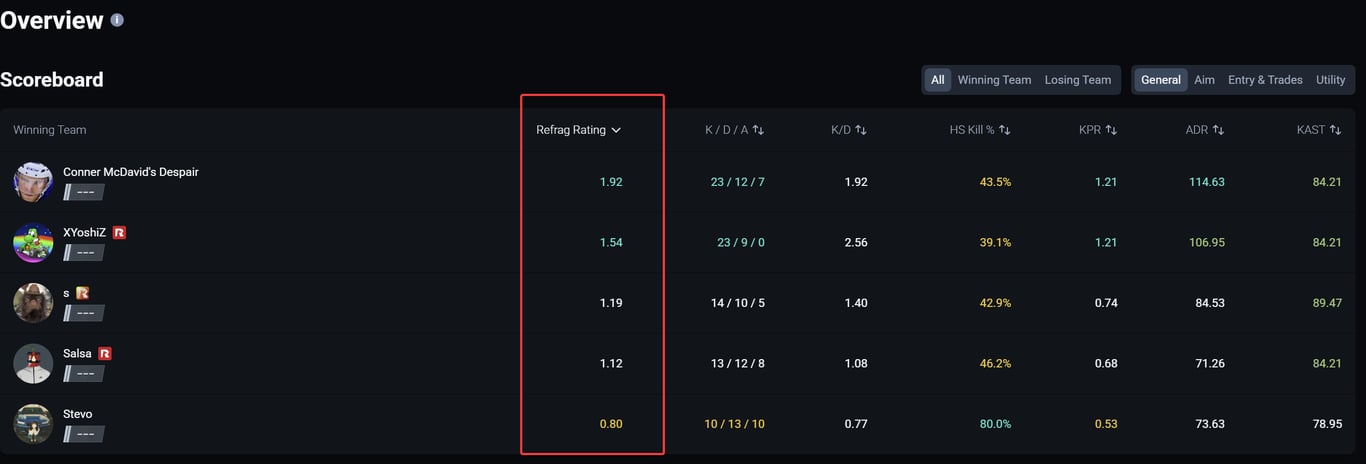
Refrag Rating is built from over 30 performance metrics pulled from your Premier and FACEIT matches, and includes things like: accuracy while spotted, recoil control, crosshair placement, time-to-kill, opening success, flash assists, utility damage and more.
Every metric is normalised to a 0–1 scale so that stats measured in completely different units can be compared, then weighted according to how much each one actually matters at your skill bracket. The metrics that separate a 5,000 CS Rating player from a 10,000 player aren’t the same ones that separate a 25,000 from a 30,000, so this is reflected accordingly in the data.
Which CS2 stats should you focus on to rank up?
Not every stat is worth your attention at every level. Fixing the right thing at the right time is most of what improvement actually is.
That’s the problem Refrag Coach exists to solve.
Coach pulls your real match data straight from Premier and FACEIT and measures your actual performance across four categories:
- General — kills per round, deaths, ADR, headshot percentage, rating
- Aim — counter-strafe percentage, crosshair placement deviation, recoil control, accuracy while spotted, time-to-kill
- Utility — enemies flashed, flash duration, utility damage, and the value of utility you died holding
- Entry & Trades — opening kill success and failure rates, trade kills, trade deaths
Coach compares every one of those numbers against the benchmarks of players above your level and tells you which ones are actually holding you back. Underperforming stats are flagged in orange and red, and your strengths come back green. Instead of guessing which column of a rank table applies to you, you get a list of your own weaknesses.
CS2 Stats FAQ
What is a good ADR in CS2? Anything above 75 is solid in ranked play, and 90+ is very strong. Mid-tier Premier players usually sit around 70–75, while Level 10 FACEIT players average 80–90. Bear in mind that role matters — support players naturally post lower ADR than star riflers.
What does KAST stand for? Kill, Assist, Survive or Trade. It’s the percentage of rounds in which you did at least one of those four things, which makes it a measure of consistency rather than raw output. Around 70% is respectable and above 75% is very good.
Is headshot percentage important in CS2? It’s an indicator of your playstyle, not a measure of your skill. Players who tap and burst at range post higher headshot percentages than close-range sprayers, and neither approach is wrong. Chasing a higher HS% for its own sake usually makes players worse.
How do I check my stats in CS2? The in-game scoreboard gives you the basics during a match. For anything deeper like historical trends, aim metrics, utility effectiveness, you need a tracker that parses your demos. Refrag Coach pulls this automatically from your Premier and FACEIT matches.
Why is my K/D good but my rating bad? Usually because your kills aren’t happening in moments when they matter. Exit frags, late-round kills in lost rounds, and baiting all pad K/D without contributing to round wins, and rating systems are usually built to see through that.
Recommended Posts
 Refrag
Momentum – CS2 Training Mode By Refrag
 Refrag


