 Samuel Allen
Refrag Rating Explained
At Refrag, the grind never stops. The team have been working tirelessly to keep updating and innovating, giving you the best possible service on the market for improving at Counter-Strike. Whilst there are many things in the works behind the scenes, today we’re taking a look at one of the most exciting of all the irons in the fire: the all-new Refrag Rating (RR).
To get the full story, I sat down with Refrag Co-Owner, Full-Stack Web Developer, and Data Wizard James Madden to learn what the Refrag Rating is, how it works, and why it might just be the smartest way yet to understand your performance in CS2. In this article, we’re going to take a look at the upcoming Refrag Rating in detail and understand some of the machinations that went into the biggest spreadsheet I’ve ever seen.
What is the Refrag Rating (RR)?
To put it simply, the Refrag Rating is a 1.0 rating system which will give you an accurate number designed to represent your overall skill or level in Counter-Strike. It is calculated intelligently, often, and with extreme depth, to guarantee you the most accurate rating possible.
Naturally, the higher the number, the better. So, for example, an RR of 0.85 wouldn’t be great, whereas a rating of 1.83 would put you in the company of Jonathan “EliGE” Jablonowski, amongst others.
How is the Refrag Rating calculated?
In an absurdly large spreadsheet.
First, James and the team retrieve a whole lot of data. The data is recorded within the boundaries of Valve’s CS2 Premier Ratings. Each rating bracket, from 1000-1099 all the way up to 29900-29999, contains its own statistics, allowing for accurate tracking of how statistics change on both the micro and macro levels throughout every skill level within CS2.
The list of metrics analysed is extensive. Here’s how it looks:
- Time-to-Kill
- Time-to-Damage
- Spotted Accuracy
- Recoil Control Accuracy
- Crosshair Placement
- Initial Crosshair Placement
- Opening Success
- Opening Attempts
- Opening Fails
- Trade Kill Opportunities
- Trade Kill Successes
- Traded Death Opportunities
- Traded Death Successes
- Shots At Low Velocity Rate
- Headshot Percentage
- Average Damage Per Round
- Damage Per Shot
- Headshot Kill Percentage
- Enemies Flashed
- Rounds Survived
- Damage
- Shots Connected
- Kills
- Deaths
- Assists
- Two-Kill Rounds
- Headshots
- Utility Damage
- Flash Assists
- Average Flash Time
- Kills Per Round
Once all this data is compiled, it looks something like this: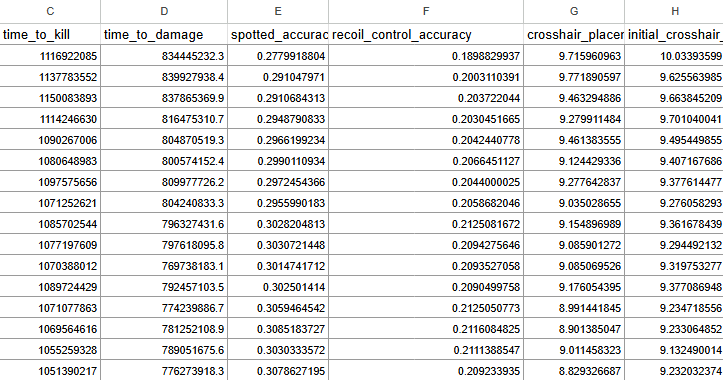
Now, all of this data comes in a variety of different metrics. For example, you have Flash Assists calculated as a raw number, Flash Time calculated in seconds, Crosshair Placement calculated in degrees, and so on. This means that the data needs to be compiled in a way that standardizes it, in order to be amalgamated into an accurate centralized rating.
In order to achieve this, the data is normalized to zero. This means that, with some mathematical magic from James, all the data is standardized so that the lowest value is 0, and the maximum value is 1, with all other data points falling in between those two values.
Now, all the data – whether it’s degrees, milliseconds, or any other metric – is normalized to one universal scale. The numbers are now operating on an even playing field, without losing any of their subtlety and accuracy.
Of course, for mere mortals, that would be enough to put together an approximate rating system which would, in technical terms, be ‘kind of good’. But ‘kind of good’ is not how Refrag operates. In order to ensure that the Refrag Rating is as accurate, insightful, and useful as possible, the data undergoes another stage of analysis.
Thanks to yet another bit of sum-based sorcery, every one of the metrics outlined above is analyzed to see how it correlates to each individual rating bracket. This means that, for every rating bracket, Refrag’s team of nerds very clever people can identify which data points have more of a realistic effect on your Premier Rating and, thus, your Refrag Rating. I have been reliably informed that this is known as ‘weighted data’.
All of this wizardry is then combined into a sleek, sexy, and highly accurate 1.0 Refrag Rating (RR), which gives you an accurate rating of your skill level and maintains consistent accuracy as you move through the ranks in-game.
The Refrag Rating is designed to be a living, breathing rating system that can track macro and micro tendencies, understand the relative importance of every data point at every level, and offer you the most accurate rating possible. As James said, “Counter-Strike is a dynamic game; we don’t want to be stuck with a static rating system”. The RR will grow and adapt to your stats, ranks, and performance in real-time and with better accuracy than an AWPer on a caffeine high.
Why is the Refrag Rating important for you?
Because you care about improving at Counter-Strike. Because you can watch your RR get higher as you get better at the game. Because numbers are cool (I had to put that in for James’ sake).
The Refrag Rating is important for you because it is the culmination of a truly deep analysis of all of your stats, correlated with your rank, and constantly evolving in tandem with your performance. It is a quickfire way of identifying slumps, plateaus, and upticks in your performance. It is also the perfect tool to make you feel good about yourself when your friend’s RR is lower than yours (for legal reasons, I will not be sharing my RR today).
Every rank is analysed. Every data point is collected. Every percentage, millisecond, and statistic is collated, correlated, combined, and crafted into the most accurate rating possible. It is the visualization of everything you’re doing right – and wrong – in one single number.
Ready to see where you really stack up?
Jump into Refrag, explore your Refrag Rating, and use Refrag Coach to turn elite-level data into real, measurable improvement.
Recommended Posts
 Refrag
Refrag Updates & Patch Notes (2024-05-13)
 Refrag


